Interactive Instruments
These three browser-based instruments grew out of the same questions that shape the rest of this work: how structure can support improvisation rather than constrain it, how constraint itself can become a form of attention, and how digital systems might serve musical thought without replacing it.
Each instrument explores a different dimension of music—rhythm, harmony, melody—through its own logic and interface. They can be used independently, but they were built to listen to each other.
Ria
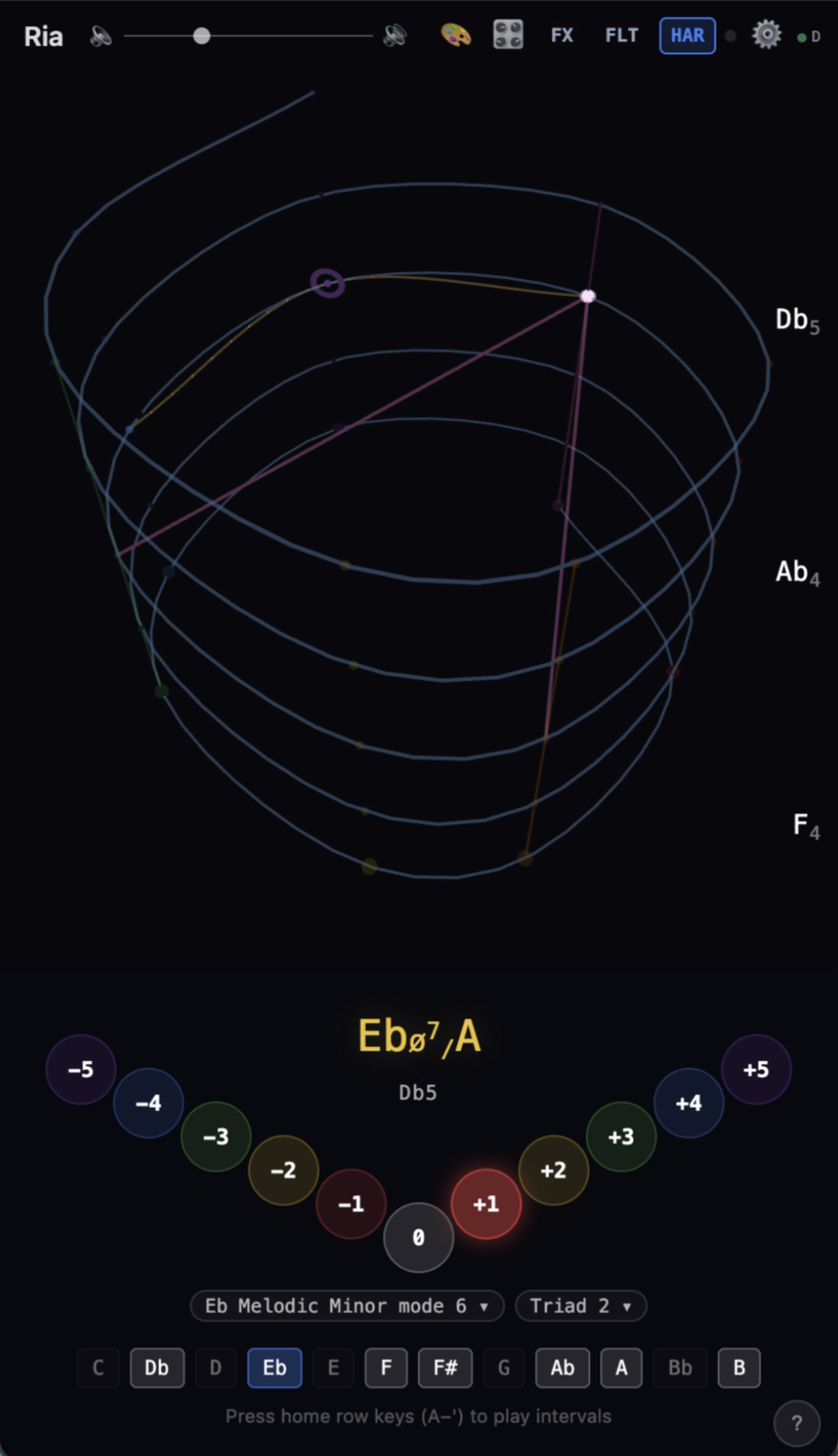
Relative Interval Apparatus
Ria is a melodic instrument organized around movement rather than position. Instead of selecting fixed pitches, the player performs interval gestures—up three, down one, same—and the instrument traces a path through whatever scale and harmonic context is active. Melody emerges from the accumulation of these relative decisions rather than from knowing where each note lives.
The interface centers on a three-dimensional spiral: one revolution per octave, with notes appearing as they are played. A generative companion called Flutter can join in—a Markov-chain voice trained on recorded performances that listens, waits, and improvises alongside the player when invited.
Ria supports microtonal tuning systems, multiple keyboard layouts, and full MIDI input and output, including MPE for instruments that speak in continuous pitch.
Euclidean
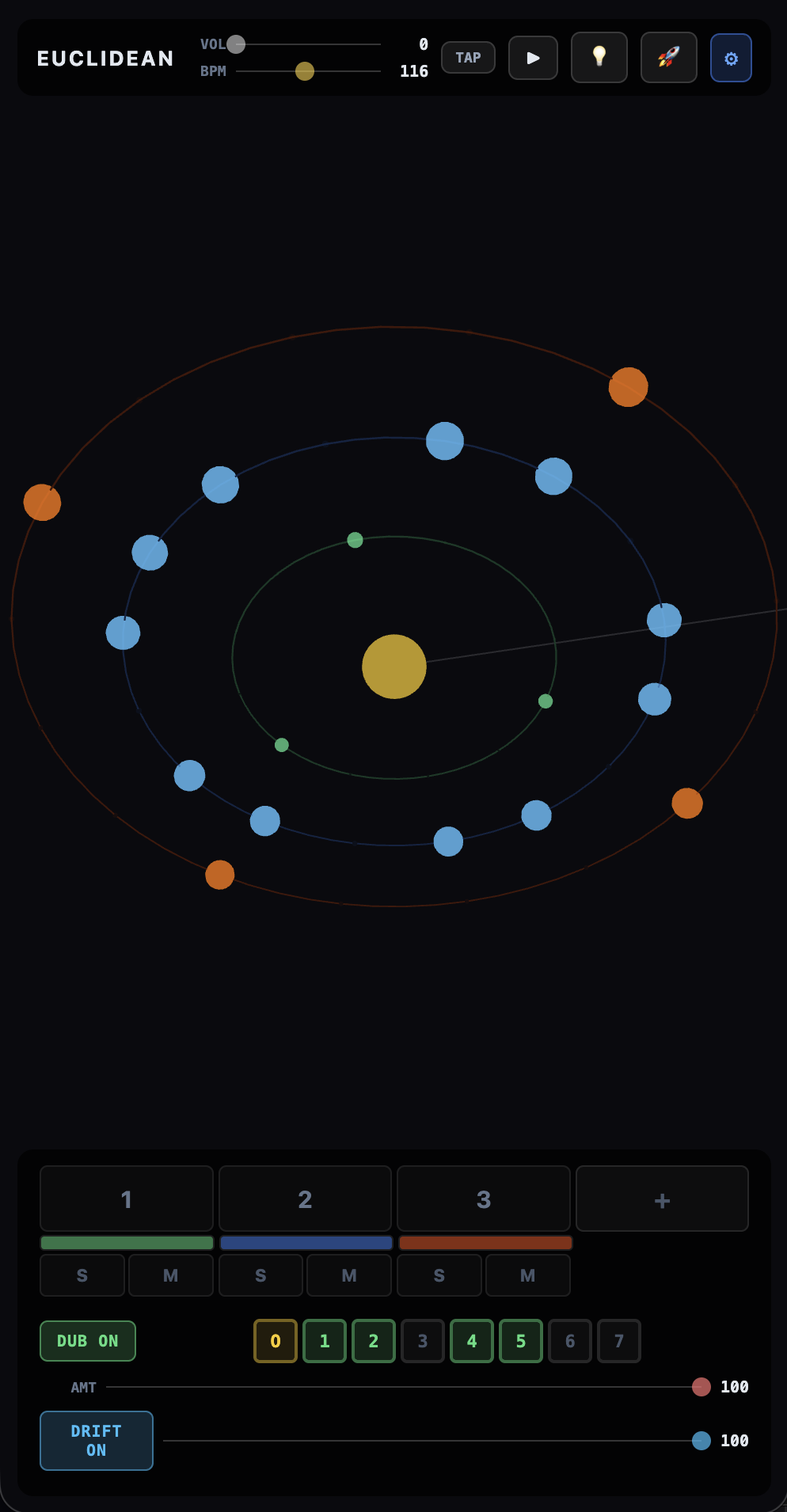
Euclidean is a rhythm instrument built on a simple mathematical principle: distribute a given number of beats as evenly as possible across a given number of steps. The resulting patterns—known as Euclidean rhythms—turn out to match rhythmic structures found across West African, Afro-Cuban, Brazilian, and Flamenco traditions.
Up to five rhythmic rings orbit a shared center, each with its own voice, step count, and rotation. A sweeping arm triggers sounds as it crosses each ring’s active steps. The visualization is spatial and immediate—you hear the geometry.
Beneath the surface, two systems add life to what could otherwise be mechanical repetition. Drift applies micro-timing offsets that give patterns a human groove. Auto Dub—inspired by Lee “Scratch” Perry’s mixing-desk improvisations—spontaneously varies volume, effects, and even the patterns themselves during playback, then quietly reverts.
Dodecahedron
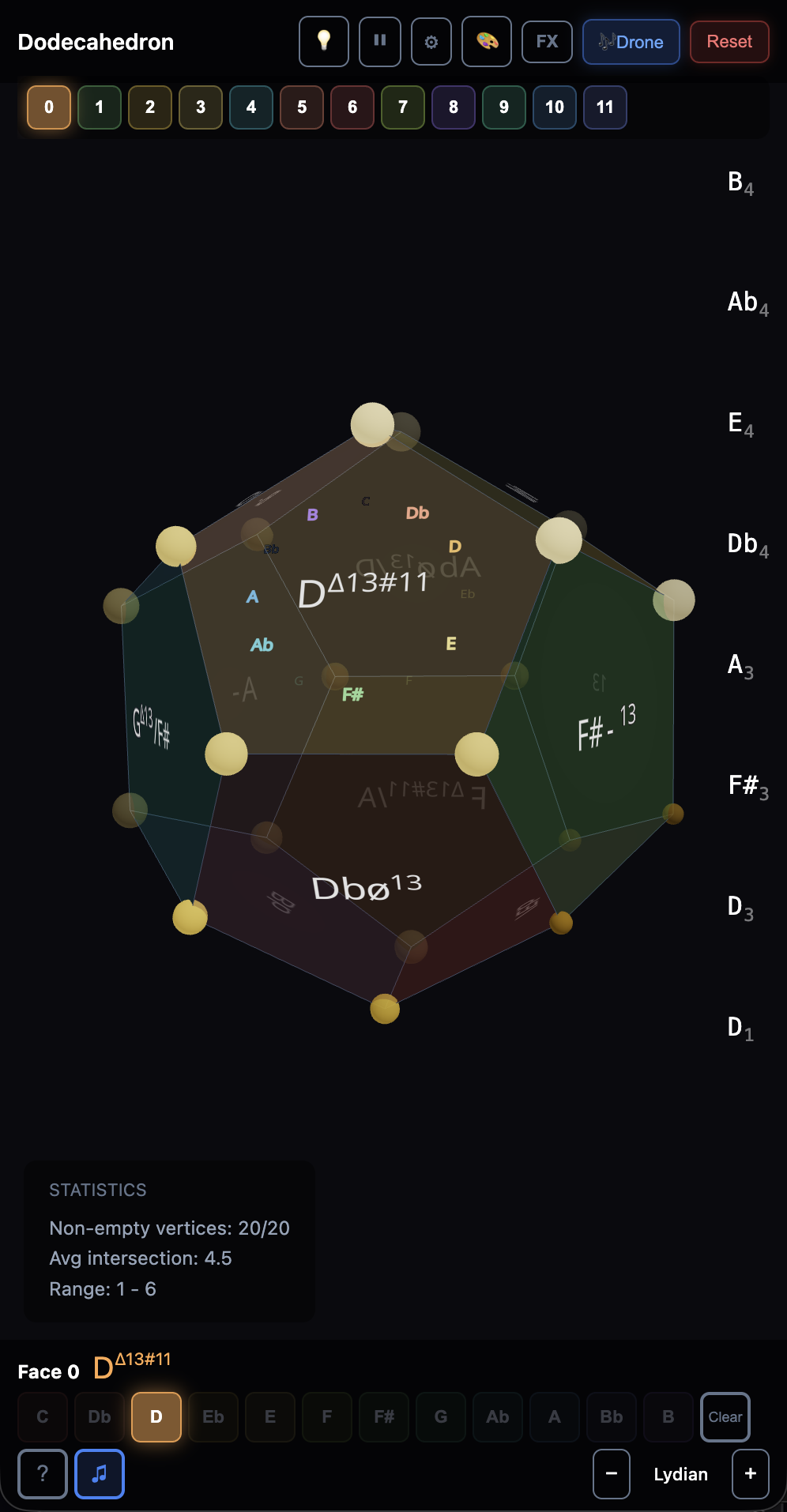
Dodecahedron maps harmony onto geometry. Each of the twelve pentagonal faces of a dodecahedron carries a diatonic scale—a root and a mode—and the twenty vertices where three faces meet reveal how those scales relate. Vertices glow brighter where adjacent scales share more common tones, making harmonic consonance visible and navigable.
The player moves from face to face, hearing chords change as the geometry turns. An auto-traverse mode can guide this navigation using harmonic gravity—weighting choices by common tones, circle-of-fifths distance, and functional resolution—so the dodecahedron finds its own path through chord space.
The instrument extends an earlier physical practice of hand-built paper dodecahedra used as scores for group improvisation. In this digital form, the geometry becomes audible, rotatable, and responsive—a space to think inside rather than a map to follow.
Together
The three instruments share a common pulse. Euclidean can send rhythmic triggers and a clock signal. Dodecahedron can establish and traverse harmonic context. Ria can receive that context and adapt its active scale in real time, so that interval gestures resolve differently as the harmony moves beneath them.
Connected this way, they form something closer to a distributed instrument than three separate tools—rhythm, harmony, and melody held in dialogue across independent but listening systems.